Showing posts with label Horse Riding. Show all posts

Thursday, 11 February 2010

Jasper

Jasper
1988 - 2010

And then he was gone.

A friend of mine, asked me “why the tears, he was just a horse, and he wasn't even yours”. Words spoken by someone, who although meaning well, has never experienced the unconditional love of an animal or the noble and generous nature of a horse who allows us to ride on it's back, making use of its speed and strength for our pleasure and purposes.


I met Jasper, or Jessie Boy as he was fondly known, one Friday afternoon in September 2007 and fell in love with him immediately. Having just signed up for an eight day horseback trek, crossing from Argentina and Chile, I set out to take lessons. My instructor came highly recommended and was lucky enough to be fit into his busy schedule. Throughout our brief phone conversation I advised him that I was a complete beginner, and my horse riding was limited to a couple of hacks at a riding school. “No, problem, you will be fine on Jasper” he reassured me.

Training for the Trans Andes Horseback Trek on Jasper, Maghtab 2007


And I was. I felt safe on the back of this gentle and patient horse with kind eyes. I had a couple of tumbles but they usually my fault. Although an intelligent animal, there was no malice in Jasper. He did his utmost for all the riders that took lessons or rode him in equestrian competitions.


I will never forget our first show jumping competition. Organised by the La Vallette Riding Club, it meant that he had to journey by van from Maghtab to Marsa, and spend a day in a field devoid of the luxury of his own stable. Moreover, he had to wait for the other horses, he travelled with, to be ready from their competitions before he could go back to his stable. My nerves at competing for the first time in a class full of seasoned riders were calmed by the fact that I could trust Jasper. Tackling the course, keeping in my the techniques learnt combined with some vocal encouragement from my part we managed a clear round. Since, two other riders were clear there would be a jump off for first, second and third place. The activity of the day, took its toll on Jasper and our time saw us place third. However I was ecstatic. I knew that Jasper had given his 110%, in the true generous nature of the horse he gave it his all.


Just after the showjumping competition in Marsa, Jasper is on the right. Marsa 2008

Some people mistakenly believe that horses are devoid of emotions and thus incapable of forming a bond. These people would have you believe that horses are not capable of feeling the same emotions that we humans feel. How wrong they are. Horses desire companionship just as much as we do. A clear example of this was Jasper's bond with Tuta, my instructor's other horse. Their stables and paddocks were next to each other and you could see him look out for her if she was out in the field and he left on his own in the paddock. He would call out to her when he would hear her walking into the stables. So close was his bond with her, that if they both were in the field at the same time he would do his utmost to follow her.


Walking through the stables, early in the morning, smelling the fresh hay, the sound of horses munching contentedly and the sight of them acknowledging my presence as I walk in gives me a sense of peace. Alas, Jasper is now no longer there to welcome me, but his hoof print is clearly embedded in my heart, just as much as it is embedded in the heart of all the riders that have ridden Jasper over the years.


Rest well, Jasper, you will be sorely missed.

Saturday, 31 January 2009

Getting back on the saddle

Holding the reins in my left hand, I gingerly put my left foot into the stirrup and swing my right leg over Daffyd's back. Gently I settle into the saddle.

Daffyd makes no movement, waiting till I gently nudge his girth with my calves, signalling that I want him to start walking, making our way out of the stables, slowly, onto the road that leads to the practice arena.

It has been three weeks since I entered that very same arena on Daffyd's back. Three weeks since I flew off, knocking myself unconscious, causing the most unpleasant headache which led to three weeks of rest at home.

My doctor has now given me the all clear. I can start riding slowly again. No jumping for the time being. I won't beat around the bush and say that I am not apprehensive. There is no such thing as a fearless person, fear is one of the most basic human emotions and it serves us well protecting us from danger. In our society admitting to fear is tantamount to showing weakness. But in reality it is not. It is a responsible and sensible way of limiting danger to ourselves and potentially those around us.

Closing the school gate behind me, Tommy, my instructor, advises me to take things slowly. At my own pace. There is no deadline. There is no pressure to prove anything. At the first instance of discomfort I must stop. Things will fall into place, he reassures me whilst I head for the Dressage arena.

Steering Daffyd around the arena a couple of times, I gently progress into a rising trot, achieving an immediate rhythm which Tommy is very pleased with. Slowly we start working on some basic dressage exercises – twenty metre circles in different directions and areas of the school, changing rein, practising a square halt – which requires the horse to bring his fore and hind legs in such a way that when viewed from the side the legs are perfectly in line.

Seeing the direction the training session is taking, Tommy encourages me to undertake a preliminary dressage test. Upon completion, although requiring some fine tuning, the result was very satisfactory and saw me with a grin as big as that of a Cheshire cat. My lesson is over and we slowly head back to the stables.

In equestrian sports, most of the physical work is carried out by the horse but it is the mental attitude of the rider that defines one's limits. Being confined indoors for three weeks, with little to do, gives growth to a number of negative thoughts. It gives you time to start creating a number of “what if” scenarios. Couple that with comments from well meaning friends who give a very graphical example of what could have happened is not conducive to gaining back the mental conditioning required. Ultimately, we need to confront our fears but we must do it in our way and speed. I am just going to do that.

Having stiff muscles from riding again is a great feeling!

Monday, 19 January 2009

Riding into the Sunset

This article was written almost a year ago following my return from the Trans Andes Horseback trek. The article was published in the July edition of the Sunday Circle. A special thanks goes to the editor Sarah Puntan Galea.

Only one small piece of luggage remained on the revolving carousel which slowly ground to a halt. My luggage, containing all the equipment necessary for my Trans Andes horseback trek is lost somewhere between London and Mendoza, Argentina.

I am exhausted, alone, in the middle of a deserted arrivals hall, on the other side of the world. Realising that my luggage won’t arrive in time, there is not left for me to do but find my hotel and nurse the migraine that had started playing a symphony in my head.

Adrenaline rush

As an adventurous spirit searching for an adrenaline rush, my participation in the Trans-Andes Horseback Trek was a dream that I had ever since I was a little girl. The time never seemed right though…until September 2007 when bored at home one evening, I decided to do a Google search on adventure travel. The first result was a horseback challenge in aid of the Prince’s Trust in the UK which was set up in 1976, by Prince Charles, its purpose being to improve the lives of disadvantaged young people in the UK.

The Challenge consisted of a six-day trek starting off from Mendoza, Argentina and finishing in Santiago, Chile. It would involve riding up to eight hours a day, climbing up mountain passes as high as 5,000 metres, galloping through wide valleys, jumping over streams and negotiating river crossings.

There was only one slight problem. I did not know how to ride a horse. Not exactly the right qualification for such a challenge.

Learning to ride

Signing up for the trek prior to finding an instructor would be the driving force to get me started. Luckily I found a patient and good instructor willing to take up the challenge and getting me up to standard. Come rain or shine I would take lessons, when possible go out on longer rides just to get used to sitting on the saddle. I discovered muscles I never thought I had!


Although I was growing quite comfortable in the English saddle I was using, the trek, being in South America, would see us ride Western style. This style evolved from the ranching and warfare traditions brought to the Americas by the Spanish Conquistadores.

Trans Andes Horseback Trek

Mendoza, situated at the foot of the Andes, was our starting point. Being the only participant from Malta, I travelled separately from the rest of the group and met them in Mendoza a day before we started our trek. Fortunately some of them did not travel as lightly as we were supposed to and could afford to lend me some items of clothing.

Our team leader Louise was instrumental in helping me rent out vital missing equipment – sleeping bag, waterproof trousers and thermal clothing. I just hoped that what I managed to borrow would withstand the possible climate and not end up feeling uncomfortable or cold.

Following a detailed briefing by our guides, it was time to set off on the first part of our journey, a three hour coach ride out of Mendoza to Scaravelli where we met the other gauchos who would lead the trek, prepare our food and ensure that we had a pleasant and safe journey.

The Challenge begins

The horses we were allocated were based on our riding experience and would be our companions for the whole adventure. At this point, it all started to sink in: Here I was at the foot of the Andes, waiting to be given a horse that I would ride, on my own, over a six day stretch.


Many questions started flooding my mind. Would I cope with a strange saddle, would I bond with the horse, would the weather be fine? Happily one of my fears was soon allayed when I was introduced to Mio, a huge six-year-old chestnut with kind eyes. Rodrigo promised me that he had a gentle nature and that I would be fine.


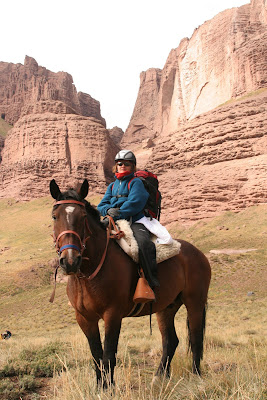
With border formalities over, we mounted our horses and set off on a four-hour ride into Quebrada del Arroyo Grande – a vast ravine high in the mountains which would eventually lead us to our first campsite – Scaravelli lodge. As soon as I sat on the saddle, I immediately felt comfortable – in fact it is much more comfortable to sit on a western saddle, mainly because of all the padding that is placed on the hard leather frame. Though the differences in equipment appear dramatic, in reality there are fewer differences between ‘English’ and ‘Western’ riding, than most people think.

A slow steady pace takes us uphill, on uneven rocky ground. I start thinking about whether I am crazy but, looking at the scenery, absorbing the beauty of the nature around me, I start to relax.


My reverie is soon broken when the horse in front of me suddenly stumbles and falls back, sending Claire flying onto the sharp, rocky ground. I am horrified. Claire is an experienced rider and had never, in her 15 years of riding, fallen. Although she confidently mounts her horse and continues the ride I am quite shaken. This happens just 30 minutes into the ride. I start thinking that perhaps all this was not such a good idea. But I am here. There is nothing I can do. I need to compose myself, concentrate and keep on going.

We set up camp at Scaravelli, in a place called La Mula Muerta - one would think that the name didn't augur well however we were in a sheltered area complete with a corral for the horse, a sheltered kitchen where our gauchos prepared a delicious barbecue and a clean bathroom......yes I am not joking, we had a clean toilet in this campsite!


Honing horse skills

The next day, after breakfast, we embarked on the first part of the day's journey which would take us on a three-hour ascent to the Argentine Portillo, a high and narrow pass cutting through rocky cliffs, standing at 4,380metres. Reaching the Portillo I quickly realise that the way down was going to be quite frightening. The winding track was just about a metre wide and beyond it was a slanting scree. Falling down that scree would not be at all pleasant, so I am not ashamed to admit that at this point I froze. Not usually afraid of heights, abseiling down Mosta bridge headfirst is one of my favourite adrenaline rushes, here I was worried. The difference being that in this situation apart from trusting myself, I had to trust my horse.


Seeing the fear in my eyes, Rodrigo offered me two options – walk down leading Mio in the process or else trust the horse and ride down slowly. For a few seconds I weighed my options – the former was really not going to happen – I was here to trek the Andes on horseback not on foot. Putting full trust in Mio we walked down, slowly, the steep scree. What was a half hour trek seemed an eternity but we made it safely and by nightfall we were all laughing about it over dinner.

The next morning we gave the horses a well deserved rest. After lunch we set off on a short exploratory ride down the valley to Laguna de Los Patos.


It was during this trek that I experienced my first jump. Jumping usually comes almost naturally to horses but both the horse and rider have to have their techniques honed. Combined together we had none! Apprehensive as I was, I had no choice. I had to cross the stream. There weren't any options this time. The terrain gave Mio the necessary space and freedom to stretch out. Following his effortless movement we made it to the other side.

William Faulkner's words came into mind: “There’s something about jumping a horse over a fence that makes you feel good.” I was not feeling good, I was feeling ecstatic! I had done my first jump and I loved the feeling. I realized that I had come along way since my first riding lesson.

The daily challenges continue…


Day four into the trek and we were faced with another challenge – that of crossing, roaring waters with strong currents. As a safety measure we were instructed to wear our backpacks on one shoulder – serving as a quick release should we accidentally fall. If this happened, we were reassured that two gauchos would be positioned on either side of the river bank, armed with ropes which would be thrown in our direction and which we would need to grab so that we could be pulled in to safety.

One by one we coaxed our horses through the river. The currents could be felt pulling at the horses’ feet. There was no stopping. Squeezing Mio's flanks gently we slowly crossed the river. The lack of hesitation from Mio's part was so reassuring, helping me build a stronger trust in him as each day passed.


The weather started deteriorating. A cold biting wind started to blow. The fleece I had managed to borrow was warm, but did not protect me from the wind. I could not help but pray. As we climbed to approximately 3,500 metres we could see Tupungato looming above the dark clouds that started to form above us. A light drizzle started to fall. The wide grassy plain in front of us gave us the opportunity to ride into a fast canter, which the gauchos hoped would bring us closer to Palmares Valley in time for the night.

We did not make it to Palmares. The wind became stronger, and it was decided that it would be safer to find the first sheltered area and camp for the night. We would have to make up for the time lost on the following day, hoping the weather would clear up. The wind made it very difficult to set up the flimsy tents and all of us were wondering whether we would be flying away with our tents during the night!
The next morning, the wind had died down and the temperature was much colder as it had snowed during the night.

Achieving a dream

Our last day of riding would see us reach the steep Portillo Piuquenes – the official border between Argentina and Chile. Standing at 5,000metres it would be the highest pass in our trek. Welcomed by Matthias, waving a Chilean flag, it was time to bid farewell to our horses as Argentine horses are not allowed to enter Chile.


I never thought I would feel so sad at saying goodbye to Mio. I was not the only one to shed warm tears. Mio seemed to sense my sadness and just stood by me whilst I stroked his neck. Trying to lighten up the moment, I joked with the gauchos telling them that I would gladly give up my luggage should it arrive in exchange for Mio.

It was time to go.

Bidding a last farewell, we mounted our new horses and started a three-hour descent towards Plomo River. Reaching San Gabriel we went through Chilean customs formalities and effectively the trek was over.....

..... and I had achieved my dream of riding off into the sunset.
Wednesday, 14 January 2009

My latest (mis)adventure

I don't recall much of the accident.

My last recollections are those of jumping my horse Daffyd over a course in preparation for the next day's show jumping competition followed by Leli, the stable owner, cradling my head and telling me not to worry as the ambulance was on its way.

Ambulance I think? Why? Then I recall that there was a fall somewhere in between. But how fast were they to call an ambulance, it is only a fall, not my first. Then the realisation, that this might be more serious than I'd like to think, sinks in.

The pain in my head and the nausea are unbearable. My first reaction is to see what degree of mobility I have. I have heard of too many accidents not to be aware of the potential hazards. Thankfully I can move although Tommy, my instructor, and Leli are begging me to stay still.

I ask if my horse is fine and when I am told he is I am relieved. One less thing to worry about but I can't help thinking that this will be a huge setback on my riding experience since potentially I could lose my nerve and give up riding altogether.

I can hear the ambulance from a distance, well perhaps not such a distance after all as soon after I can hear a doctor asking me what happened, my name etc. My rescue training skills come back to mind when the doctor starts explaining the procedure, what kind of treatment they are giving – just as though a spinal injury has taken place. I know its procedure but still I get a bit worried.

All this has made me tired and want to sleep. Jenny, a fellow rider at the stables has taken the trip on the ambulance with me, tries to keep me awake by constantly calling my name.

I hear a siren, is there another ambulance in the vicinity I wonder? It isn't the case. It is the ambulance I am in being transported in. I feel very disoriented and confused. I try remembering Conrad's number but no luck, I have to ask the guys to take my phone, which I left in my tack room, to call him and advise him. I would have preferred speaking to him myself but I had no choice.

Arriving at the Emergency department, I feel very relieved when I see Herta, Conrad's sister, waiting for me. Such a friendly and familiar face is very reassuring. A doctor comes in to assess the situation, I know him slightly. He asks me how I am feeling ....to which I dryly reply that I have seen better days. He asks me what happened but I don't remember much. Jenny fills him in following the account that Tommy gave her prior to leaving for hospital.

Conrad arrives, I guess he is relieved to see me alive following Tommy's call. I hear his voice, muffled but very concerned. He patiently waits next to me, holding my hand till it is time for an X-Ray and CT scan. Apparently it took quite some time till it was my turn but I don't realise this. I am lucky the CT scan shows a slight brain haemorrhage but no fractures. The doctor says I am very blessed as it could have been worse....much worse.

As is normal procedure I have to stay in hospital under observation for at least 24 hours. Since there has been a head injury, I cannot eat or drink as it might induce vomiting and that could be dangerous to the brain. I am given an intravenous drip which is very uncomfortable but at least the straps and the spinal board are finally removed. They were very uncomfortable, making me feel very claustrophobic....a feeling that I am normally oblivious to!

The next couple of hours are hazy. I only start to focus a bit when friends start coming to see me during the hospital's strict visiting hours routine. Although I try to set their mind at rest by trying to look wide awake and smiling, in reality I am very tired and feel like a zombie. The pain in my head won't go away and finally I fall asleep even before some of them leave.

Thankfully I manage to sleep at night and if it was the case that I was being woken up at regular intervals, this procedure did not affect me. What affected me was the wake up call at 5am – what a rude awakening. Hospital staff start shouting orders and moving objects around as if it were midday. The cherry on the cake was the religious chanting of an old lady, two beds away from me....the double portion was the nurse joining her chants at the top of her voice I felt like chanting a chain of expletives but where would have that taken me? Nowhere!

To my joy I am discharged a few hours later, with strict instructions to rest and take things easy for the next couple of weeks.

I am now resting at home. A slow steady progress towards getting back to my hectic lifestyle. This (mis)adventure has taught me, if anything, that it is during these times you will (1) realise what is really important and (2) who your real friends are.

Having 600 friends on Facebook or on your contacts list doesn't really mean anything if they are just there to add up the numbers.....it is those few friends, who regularly check on you, whether by means of a phone call, SMS, email, message or visit, to make sure that you are still alive, to see if you need anything, to make you smile if you are sad and need cheering up, are those that really matter.

This blog post is dedicated to all those friends who cared.

You don't know how much you mean to me!

Wednesday, 26 November 2008

MEMORABLE QUOTES


"A horse is the projection of peoples' dreams about themselves - strong, powerful, beautiful - and it has the capability of giving us escape from our mundane existence.”

Pam Browne

Thursday, 19 June 2008

The Art of Dressage

"Riding a horse is not a gentle hobby,
to be picked up and laid down like a game of Solitaire,
It is a grand passion"

Ralph Waldo Emerson (1803 - 82)


Dressage, a French term, most commonly translated to mean "training", is a path and destination of competitive horse training.

Its fundamental purpose is to develop, through standardised progressive training methods, a horse's natural athletic ability and willingness to perform. Dressage is occasionally referred to as "Horse Ballet"

Prior to setting off on my Argentine Andes adventure I had no inclination to participate in competitions, although giving up riding had clearly not become an option.

On the 31st May 2008, I participated in the pre-preliminary Dressage competition at the Tal-Maghtab Stables. The heat of the afternoon sun was beating upon Jasper and myself. Although each rider takes approximately four minutes to complete the course, it felt like ages before I could start practising.


A foreword in a book I recently read about horse riding describes the horse and its rider as a six legged creature. Mounting the horse is just not merely seating oneself on a form of transport but a metamorphosis occurs making the horse and rider into one.

It is soon my turn. Dressed in accordance with the formality of the competition, I no longer feel the heat in my black jacket. I hear the whistle. It is time to start.


Although I have practised the course regularly I am afraid that I will forget the sequence of exercises. Will I lead Jasper properly to form a correct twenty metre circle? Will I change reign at the right time? As soon as I enter the school I become one with Jasper. We are ready!


Throughout the course, I block all that is around me. All I can hear is Jasper breathing. Soft words of encouragement are said, his ear's movement indicating an acknowledgement.


In four minutes I have completed my course. I halt at the imaginary G and salute the Dutch judge who in an gentlemanly fashion stands up and lifts his hat, saluting me back.

It is over. I have thoroughly enjoyed this experience. Whatever the outcome, I am satisfied.


Author's Note: My satisfaction was further enhanced when it was announced that I had placed third in my category. I had competed against seasoned riders and I had done well.

Photography - Conrad Chircop May 2008

Monday, 21 January 2008

Preparing for the Trans Andes Horse Trek

The Trans Andes Trek is an eight day horseback trek covering 150 kilometers on horseback, starting from Mendoza riding into the Andes passing through pristine mountainous environments, camping along the way in areas such as Rio Tunuyan, Real de la Oveja, Portillo Argentino, Base of Tupungato finishing in Santiago in Chile.


The trek will start on the 2nd February and will end on the 10th. Some days will see us riding for three hours but others will see us riding for over eight hours. Naturally such a trek requires a good degree of confidence in the saddle and that is why, for the past four months, I have been training regularly over the weekends and when possible even during the week.


This trek is being done for charity in aid of The Prince's Trust in the UK, which is now in its 30th year and is a leading charity in the UK. Its objective is to help young people aged between 14 - 30 years of age to overcome barriers and get their lives working. Their focus is on those who have struggled at school, are in care, long term unemployed or even have been in trouble with the law. Through practical support, training, mentoring and even financial support these young people can discover their true potential and thus transform their lives into success stories.

More info - www.princes-trust.org.uk

Photos taken by Jeremy de Maria

Saturday, 17 November 2007

Riders on the Storm

Ironic or appropriate that this morning, whilst out for my horse riding lesson, I was riding Storm, when a hailstorm hit us over the Mtahleb hills.

Leaving the stables under a blue sunny sky gave us little concern for potential rain although once we were well on our way to Mtahleb one could see flashes of lightning, followed by the rumble of thunder. Shortly after we were hit by a hailstorm which apart from covering us with small white hailstones led to a sharp drop in temperature, making the horses feel uneasy.

Gentle encouragement whilst keeping a firm contact always helps and it was quite satisfying to see Storm calm down and continue the trek following my commands - after all I am still learning to ride and lack experience.

By the time we got back to the stables all of us were cold and wet, but I am sure I could see in Storm's eye a small glint of satisfaction - we weathered the storm and came back home safe and sound.

Now really this has nothing to do with the song performed by The Doors, except perhaps the thunder and rain sound effects and Ray Manzarek's Fender Rhodes electric piano playing which emulated the sound of rain.


Still, this weather this morning inspired me to write this piece.